Welcome!


This is where I note my efforts as I try to recreate some old recipes. Most are taken from my small collection of handwritten recipe books which date from the late 1700's to around 1922. I also have a collection of old tatty old recipe books, well thumbed and heavily splashed from years of use. I love all of them.

The old-fashioned very stylised handwriting writing is sometimes difficult to decipher, measurements and cooking instructions are minimal, no tin sizes given. Luckily I enjoy a challenge. Just to complicate things I cook and bake on my wood-fired Rayburn, which can be... unpredictable.

I suspect this blog is less about the food and more about my passion for these lovely old books and the wonderful women who wrote them.


Saturday, 22 April 2017

Stuffed Monkey

Stuffed Monkey - how could I resist?
I found the recipe in 'English Food' by Jane Grigson, 1974.
My initial reaction was to wonder what on earth such
a recipe could be doing in the 'Teatime' section
along with cakes, scones, bread and buns.


Rest assured, no monkey was harmed in the making of this dish.

It is something of a mystery as to how it got such a name.
Jane Grigson got the recipe from a Jewish Cookbook
written by Florence Greenberg.


My interest was piqued, not least by the unusual name
and
also by the apparent simplicity of the dish.


Recipe

6 oz flour
Half tsp cinnamon
4 oz butter
4 oz soft brown sugar
1 egg, separated

Make a dough with the flour, cinnamon, butter, sugar and egg yolk, mix it as though making pastry.
Roll it out and cut into two rounds to fit into an 8 inch cake tin.
Fit the first round into the buttered tin.


1 1/2 oz butter
2 oz chopped peel
1 oz caster sugar
2 oz ground almonds
1 egg yolk

Melt the butter and then beat in all the other ingredients.
Spread the mixture over the pastry.
Cover with the second round.
Tuck the edges in neatly.
Brush with the egg white.
Bake at 190 C/375F for about 30 minutes.
Cool in the tin and then turn out carefully.


The outer case is crisp and flavoursome while the filling is almost marzipan-like,
 very dense, rich.
It is a fabulous teatime treat
or
a coffee-time treat.
Any time treat.
Indulge yourself!

Easy to make.
Stores well.
Tastes delicious.
Excellent!


Wednesday, 19 April 2017

Herb Pudding for Spring

This first pudding was traditionally made in Staveley Village, in Westmorland - the North West of England.    It can only be made in Spring, when the nettles are young and tender and when wild green herbs grow in abundance.

You will need:

Any kind of edible young green herbs, wild ones
such as Easter ledges (none available around here, I used wild garlic instead)
young nettle tops (wear rubber gloves!)
young dandelion leaves
lady's mantle (alchemilla)
or your choice of spring herbs - several handfuls.
One hard-boiled egg
One raw egg
Half an ounce of butter
pepper and salt.


We have lots of nettles, plenty of dandelions, lady's mantle, wild garlic and chives, so that's what I settled for.   Easier said than done, though.  

The first problem I encountered was that of finding enough young dandelion leaves, preferably located in places where the dog could not possibly have lifted his leg...     The nettles came from Owl Wood and so did the wild garlic.    Lady's mantle came from where the old summerhouse was located and the chives from the herb garden.

Wash them thoroughly!    Really thoroughly, it is amazing what comes out of those greens.    I'm squeamish, I know, but I also know what runs around our gardens and the woods at night time.    Just saying!

Put the greens into boiling water and boil for 10 minutes.

Drain.    I drained and squeezed until the greens looked like dry boiled spinach.   (I should have squeezed a third or fourth time, for I ended up with a small puddle around the pudding.)   Then chop the leaves and add the finely chopped boiled egg.

Next, add the beaten egg, the butter and seasoning.

Return the whole to the pan and cook through briefly.

Put the (tiny) mixture into a hot pudding basin to shape it, then turn it out and serve.


I popped a wild garlic flower on top for decoration.       You can see that pesky liquid around the base.


Taste test:   Surprisingly delicious!
Would I make it again - Yes, I probably would.


Another Herb Pudding,   this one comes from a different Westmorland village,  Burnside.

The basics are the the same, but you leave out the raw egg and add a couple of tablespoons of boiled barley.


I am a fan of pearl barley, I like it in soups and I liked the addition to this pudding.   It just added a little more body to the dish.   Less juice dribbled out of this one, I had almost wrung it out sufficiently!


The dish is really intended to be served as a side dish to meat.
The recipe came from Florence White's book - Good things in England (1932)


Playtime over, I got down to the real business of the day...


Four individual apple crumbles and a loaf of no-knead bread.
x

Sunday, 16 April 2017

Baking and Cooking

It has been a busy time, here in Parsonage Cottage Kitchen.
Lots of cooking and baking, virtually no photographs because I was too busy.
This one more than makes up for it, for me.


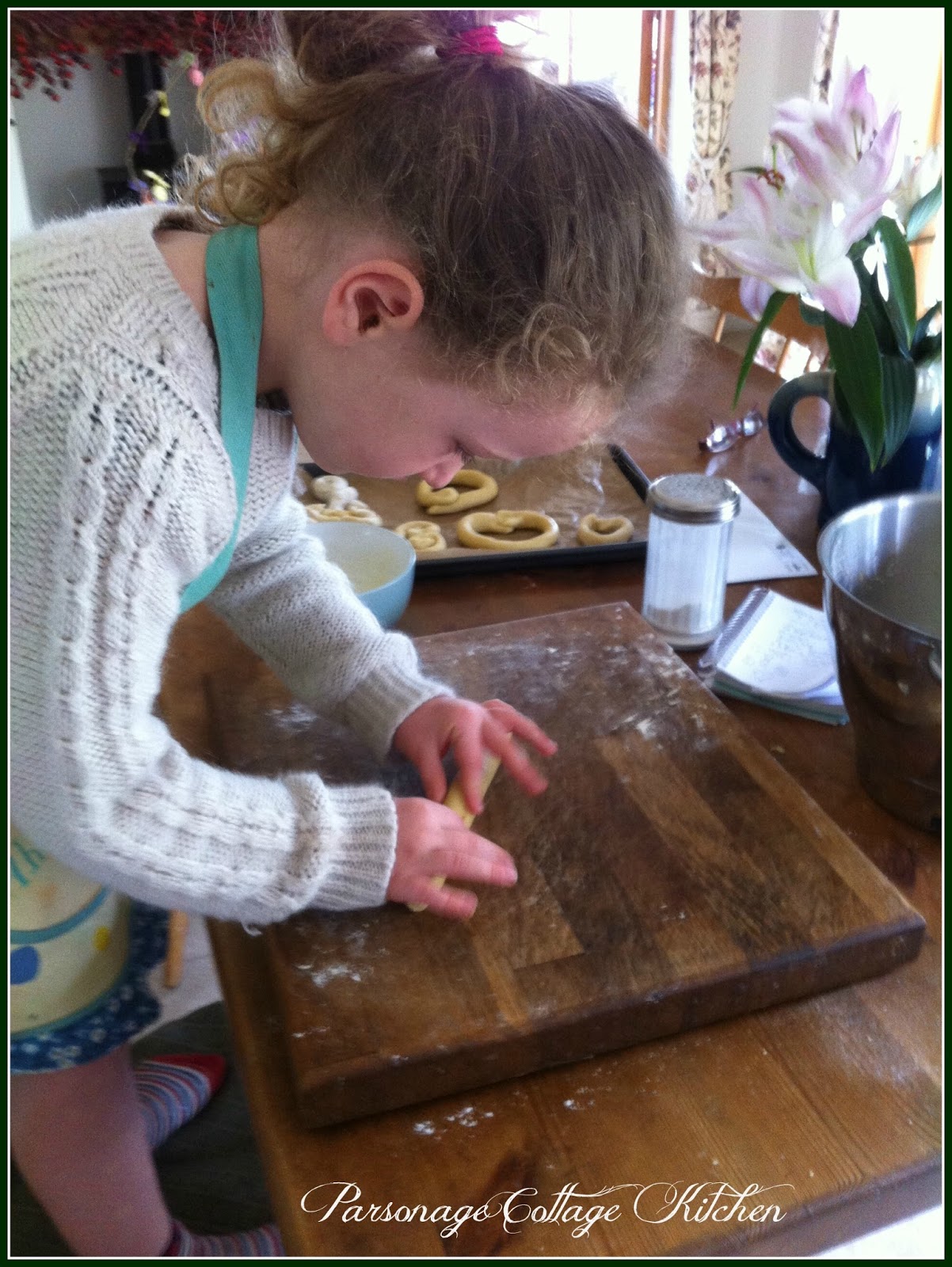
Young Merry made a batch of koulourakia, Greek biscuits.   Thanks, Linda.   They were enormous fun to make and were enjoyed by all the visitors.

I set aside my personal scruples, roasted a large ham.   I made sure that it was British and outdoor reared, I had to at least have the consolation that the poor pig had had some quality of life.    I also roasted a large chicken - free range, of course.   That was the less than pleasant stuff out of the way.


Baking:

A very large quiche, mushroom, wild garlic and cheese.
A vast Lemon Meringue Pie
Chocolate Cake, with frosting.
Carrot Cake
Two varieties of bread
Hot Cross Buns
Koulourakia
Shortbread


Roast Ham
Roast Chicken
Tabbouleh
Mixed Salads
Boiled New Potatoes with Mint, Butter and Sea Salt
Crudites and Hummus

plus all the things which I bought rather than made - cheeses(!) ice cream, pickles, etc, etc.


We were feeding all three of our adult children, their partners and children.   The party was twelve in number and food disappeared at a rate of knots.   Even so,  there was plenty left over.

I made sure that they all took parcels of their favourite left overs, but there is still a fridge full of deliciousness.   No need for me to cook or shop for quite a while yet.

I need to lie down in a darkened room to recover.
x

p.s.  Everyone sends their love, Ian.   They wanted to know about the boat and your adventures!xx


Thursday, 6 April 2017

Rhubarb and Ginger Lattice Tart

I came across this recipe a long time ago.    The original recipe calls for apples and cloves, but I am using rhubarb and ginger.       Our rhubarb is coming in thick and fast now, and although Max would be delighted if I were to serve rhubarb crumble every day, I like to ring the changes.


It is a delicious mixture of soft and crumbly, slightly gingery, cake base with fairly tart fruit and then topped with crisp ginger lattice-work.     The only trouble is, Max would also be happy to eat this every day, too.     Now I need to find another way to use the rhubarb.


Rhubarb and Ginger Lattice Tart

7oz self raising flour
5oz butter
a pinch of salt
1 teaspoon ground ginger
3oz brown sugar
1 egg
12oz rhubarb cut into short lengths
2/3 tablespoons redcurrant jelly
1 tablespoon sugar

I baked mine in an 8 inch square, loose-bottomed tin.  Grease the tin and line the base.  160C


Cream the butter and brown sugar until light  and fluffy, add the beaten egg, a little at a time and then gently mix in the flour and ginger.

Reserve about a quarter of the mixture and spread the rest of it on the base of the tin.

Lay the rhubarb on top of the mixture.    Warm the redcurrant jelly and then brush it over the rhubarb and sprinkle that with the tablespoon of sugar. (more if you like things to be sweet)    It probably won't spread evenly, but it will be fine!

Take the rest of the mixture, and roll it out so that you can cut it into strips for the lattice-work.  Then decorate the top of the rhubarb with strips of the dough.   Tuck in and tidy the edges and then bake it for approx 75 minutes.

Allow it cool in the tin for a while because it will be quite fragile, but it will firm up as it cools.

Dust with icing sugar, or not, according to taste.

Delicious warm, or cold.   You could also add a dollop of your favourite creamy indulgence, or custard.

Pretty to look at, delicious to eat.

The redcurrant jelly and sugar combine and lightly caramelise and yet the slight tartness of the rhubarb cuts through it, the cake is crumbly and slightly gingery, a wonderful combination.

It is a big favourite in our house.


Sunday, 2 April 2017

Clean Your Windows with Dandelions!


The common old dandelion can be used for so many things - from wine, beer, and liqueurs, to  marmalade, salad, cooked greens, pickles, you can even make coffee from the roots.

Today, however, I tried something different, Dandelion Cleanser.

I found the recipe on a single, ragged, page from an old cookery book which probably dates from a hundred years ago.  

Modern cookery books are sumptuous productions, full of brilliant photographs of beautifully staged and tempting foods, but I love these simple, very cheaply produced books from around the very early 20th century.    Often they are little more than a few pages, sometimes around 90 pages, usually they either lack their covers or have flimsy paper ones.    They cost next to nothing, people simply don't value them, and yet they contain so many fascinating avenues to explore.

Like this household cleaner - forget chemicals  - brew up some dandelions!


Dandelion Cleanser

Take four or five roots, leaves, flowers, and tendrils of dandelion and about three pints of water.  Boil until it becomes brown (see bottle in photograph) and about half the quantity.
Strain before use.


So far I have cleaned windows, mirrors, glass cupboard doors and the result has been excellent!

The sun has just begun to shine on the windows I cleaned earlier and I am happy to say that there are no smears or greasy marks left on them, it really does work.

All I did was wash them with a cloth soaked in the solution, I wiped the window dry with a cloth and then gave them a quick polish with a piece of old towel.


Wednesday, 29 March 2017

Parsonage Cottage Pantry


You can see from the header photograph, I don't have many cupboards in the kitchen.    What I do have, in the adjoining Boot Room, is a walk-in pantry.

I keep dried and tinned food, spices and herbs, bread, cereals, dog and cat food, glassware, some spare china and several kitchen aids in there.  

It could quite easily become a repository for 'stuff' but I fight hard to keep it reasonably well organised, after all, the cats need me to be able to put my hand on their favourite brand of cat food immediately.   

I had always wanted a large pantry and when this was finished I thought that I would never fill all those  miles of shelves...   Ha!

One thing I hadn't banked on though, was having to share the room with a cat.

Little Miss Pinkerton quietly slips in after me, goes to her favourite corner (just behind the plastic crate on the floor) and sits quietly.   She doesn't climb on shelves, so I don't mind too much.   Mostly I don't mind, because I don't notice her doing it.

Which means that she sometimes gets locked in.

The first time it happened, I was alone in the house.     Suddenly the silence was broken by the sound of a door latch being rattled...never mind the latch being rattled, I was rattled.      Heart pounding, I opened the pantry door, only to have Miss Pinkerton trot out, tail in the air, with a demand for food...NOW!

"Butter wouldn't melt in my mouth, honest!"

Ha!  Just one minute after I clicked on the button to post this, the door was rattled.   Yes, she had sneaked in there again.   I thought she was outside.   Little madam.


Saturday, 25 March 2017

Another Primrose Pudding Recipe


This recipe is taken from Florence White's "Flowers as Food"  Receipts and Lore from Many Sources which was published in 1934.


After the previous experiment in Primrose Pudding I really wanted to find another recipe for primroses, hopefully something which I would want to eat,  so I turned to Florence as she is normally quite reliable.  

She wrote "My own small collection of 'receipts' was begun as a literary hobby which proved full of unexpected interests."   

There is a recipe for Prymerose Potage, dating from the 15th century - I wanted to try that but, unfortunately, I didn't have the rice flour or saffron, though I could have supplied the honey, almonds and primroses, along with powdered ginger.

I didn't want to pick a peck of primroses to make several gallons of Primrose Vinegar, either.

So it had to be Primrose Pudding, again.        I reduced the quantity of ingredients down to a manageable level, so I divided everything by four until I came up with this:


Primrose Pudding

Dry cherries (I used crystalised strawberries as I had them in the cupboard)
Pistachios - didn't have any of these
Almonds
Fine white breadcrumbs 2oz
Castor sugar 1 teaspoonful
Suet - 1oz
Boiling Milk 2 fluid ounces
Egg x 1
Primrose petals 1/2 cup


Butter a mould well and decorate it with the cherries, almonds and pistachios.  
Wash your primroses.


Nip off the white at the base of the primrose petals.
Put the breadcrumbs into a basin, stir in the sugar and pour the boiling milk over the mixture.
Stir in the suet and the primrose petals.
Whisk up the egg to a very light froth and whisk it into the mixture a little at a time, so that the pudding may be light.
Pour the mixture into the mould so as not to disturb the decorations.  Cover with buttered paper and steam for one hour and a quarter.
Serve with champagne or some other wine sauce - I'm afraid I only had some left-over custard to hand, so custard had to do.


The taste test:   It is a steamed suet pudding, not very sweet, a little stodgy.   Much more palatable than the previous recipe, but not really suited for the way we eat today.   I don't think that even the addition of champagne/wine sauce would have improved it a great deal.

The primroses are better left in the garden, they brought absolutely nothing to the party whatsoever.   Perhaps old-fashioned primroses had more flavour!

This definitely concludes my experiments with primroses.

Time to do some work with the wild garlic.   Owl Wood is full of it and it shouldn't be too long before the flowers begin to appear - they are beautiful, but they do herald the end of the season.   I need to make the most of them before that happens.