Welcome!


This is where I note my efforts as I try to recreate some old recipes. Most are taken from my small collection of handwritten recipe books which date from the late 1700's to around 1922. I also have a collection of old tatty old recipe books, well thumbed and heavily splashed from years of use. I love all of them.

The old-fashioned very stylised handwriting writing is sometimes difficult to decipher, measurements and cooking instructions are minimal, no tin sizes given. Luckily I enjoy a challenge. Just to complicate things I cook and bake on my wood-fired Rayburn, which can be... unpredictable.

I suspect this blog is less about the food and more about my passion for these lovely old books and the wonderful women who wrote them.


Wednesday, 8 March 2017

Rhubarb Cartwheel Flan + 18th Century Recipe for Crisp Pastry, No Soggy Bottoms!


The rhubarb forcer is in danger of losing its lid; time to begin eating the early rhubarb.

I trawled through my old books but most of the rhubarb  recipes are for jams and preserves,  which seems a shame when the rhubarb is so fresh and young.     I could easily have made a crumble, or rhubarb and custard cake, but it is good to try new recipes.


A couple of days ago I was gifted a big pile of  cookery books which belonged to a lovely old man in our village.  

They are not nearly as old as the books which I normally collect and enjoy so much, but that doesn't matter.    They belonged to our dear friend Oscar, and his late wife, and have obviously been well used during the forty or fifty years they spent with them.   That reason alone, earns them some space on my bookshelves.


Ignoring the relative youth of these books (a mere 50/60 years)  the only other draw back to them is the smell.     Nothing awful, just old book smell.      I know some people love that smell.  

I don't.

Luckily I have a solution.  

You simply need a box with a lid and some fresh cat litter.     Put a good layer of the cat litter at the bottom of the box and then put your book inside* and close the lid.   Leave for a week or two, after which time the smell should be gone.

* You may want to put something between your book and the litter, just to protect the dustjacket/cover from scratches and dents.


The dish I am baking today is a flan A Rhubarb Cartwheel Flan, the recipe comes from the Marguerite Patten book, Fruit and Vegetable Cookery, which was in the pile of books that came from my old friend's house.
 
The pastry recipe comes from May Byron's book  'Pot Luck' and is an Eighteenth century recipe.


To Make Crisp Paste for Tarts

"Take one pound of fine flour, mixed with one ounce of sifted sugar, make it into a stiff paste, with a gill of boiling cream and three ounces of butter; work it well, and roll it very thin.    When you have made your tarts beat the white of an egg a little, rub it over them with a feather, sift a little sugar over them, and bake in a moderate oven."

I have never made pastry with boiling cream before - and there could be a good reason for that, but unless I try it out, how will I know whether it really works?     I suppose it is like a sweet version of hot water crust pastry - which I have never made - but I'm happy to give it a go.

I sieved the flour and sugar (I used icing sugar) together and then gently melted the butter into the cream and brought them to the boil before pouring them into a well in the middle of the flour and mixing them altogether with a  wooden spoon.

Although I kneaded it well,  I probably should have kneaded it a little more and I should definitely have rolled the dough out much thinner before lining a flan dish.

Bake it blind until it is golden and crisp.


Rhubarb Cartwheel Flan 

Filling:
12 oz rhubarb
4 oz granulated sugar
1/2 pint water

Wash the rhubarb well, trim the ends and cut into 2 1/2-inch pieces.     Dissolve the sugar in water in a large saucepan, bring to the boil and add the rhubarb.   Cook gently, just under boiling point, until tender for about 10 minutes.     When cooked, drain off the juice and allow to cool.   Keep 6 of the strips, cut the others in half and put in the flan case.   Set aside.


Ginger Sauce:

1 round dessertspoon cornflour
1/4 heaped teaspoon ground ginger
1/2 pint milk
1 level tablespoon castor sugar

Blend the cornflour and ginger with 1 tablespoon milk.   Put the remaining milk in a small saucepan and bring to the boil.   Pour on to the blended cornflour, stir well, return to the saucepan and simmer for about 5 minutes, stirring all the time.   Add the sugar and when cool, cover the rhubarb in the flan.  Arrange the 6  strips of rhubarb on the top to resemble the spokes of a wheel.

This is what I ended up with.


Just as well I am not a wheelwright!    
It was much nicer than it looks.   Rhubarb and ginger is a classic flavour combination with good reason.

The pastry was too thick, but strong and crisp, perfect for a flan, definitely no soggy bottom!


As you can see, the ginger sauce was a little bit thin and runny (in my opinion) for a flan although it tasted very good and Max ate two large slices straight away - bang goes that diet!

Despite the runny ginger sauce the pastry case remained strong and crisp, by the way.


I made the flan a second time, substituting a really thick egg custard sauce this time, which I had flavoured with plenty of ground ginger.    Success!  Though I still made the pastry too thick.  Could do better, and must try harder!

Nope, that is not a sausage on the top of the flan, it really is a slice of  pink and tender rhubarb.
I just take rubbish photographs, the flan tasted delicious!


I made an egg custard sauce, making it thicker than I would normally, and flavouring it with ground ginger.       Max was an even happier man.    

So, in conclusion, the original recipe was fine, but the thicker, ginger custard/sauce was much nicer - in our opinion, which is now making me think that I could use ginger to flavour the custard in the next rhubarb and custard cake that I make...

Watch this space!
x


Saturday, 4 March 2017

Pea and Lettuce Soup

Follow my blog with Bloglovin


So many of the soup recipes from my old books proclaim to be 'vegetable', but I read on and the list of ingredients include items such as "two pounds of neck of mutton, or a fowl"...

Eventually I found one which required only vegetables and butter, things which I had in the fridge, including a very limp old lettuce  and peas from the freezer.

Melt an ounce of butter and put two chopped onions, the peas and the outer leaves of a lettuce or two to stew in a pint of water.   Add salt and pepper.     Pulp the vegetables but keep the liquor and add to it some more water and the hearts and stalks of the lettuces with spinach leaves cut small.    Add more salt and pepper and stew until soft.

In more modern parlance:


Chop two onions and saute them in an ounce of butter.  Roughly shred the outer leaves of a couple of old lettuces and add them to the pan.   Tip in a bag of peas.   Add a pint of water and simmer until the vegetables are cooked.     Blitz the soup with your hand-held blender, then add the hearts and stalks of the lettuce, along with spinach leaves, season to taste.    I added vegetable bouillon and cooked them all together.

I also added a good handful of chopped mint because we like the old mint and pea combination.

The resulting soup was quite thin at first.   I let it stand overnight and the next day it had thickened up considerably, the flavour had developed, too.  

Reheat and then serve with fresh crusty bread, croutons, dumplings, grated cheese - whatever it is that makes you happy.


Wednesday, 1 March 2017

An even Better Victorian Chocolate Cake Recipe


The garden is full of primroses and my old recipe books have plenty of recipes which use them, but I decided to pick just a few for decoration.  

Chocolate cake is always popular with my family and this one got a big thumbs up from them.    It doesn't come with a list of ingredients a mile long.   Nor does it take any great effort.


I found it in one of my old recipe books:

8 oz flour
2 tsp baking powder
1/4 tsp salt
2 oz dark chocolate
8 fl oz milk
5 oz butter
10 oz soft brown sugar - (I didn't have enough, so 4 or 5 oz was dark molasses sugar)
3 eggs
1 tbsp black treacle
1 tsp vanilla extract

Sift the flour, baking powder and salt together.

Put the milk and chocolate into a pan and warm them gently, stir when melted and then set aside to cool.

Cream the butter and sugar, adding the beaten eggs a little at a time.   Add flour and eggs alternately.

Mix well and then add the cooled chocolate and milk mixture.

Pour the batter into tins and bake at 180 degrees - 25-30 minutes, approximately.

I used two 8" tins, but you could use smaller ones and make three cakes.


No doubt there will be more to come.
x

Friday, 24 February 2017

An Alderman's Pudding

What drew me to try this pudding was the fact that
a) it was written in one of my recipe books and
b)  Eliza Acton had deemed it to be more refined and therefore superior to Bakewell Pudding.

One of my grandsons is rather fond of Bakewell, I had to explore this, put it to the taste test.

I'd also quite like to know why the pudding was named thus.
Here is an Alderman, I borrowed his image.
He was quite a superior Alderman, just as Eliza Acton described the pudding, he was Alderman David Stone.  A Southerner, you will see why I mention that, later!

An Alderman
Image Borrowed from internet.

The recipe according to my book:

Line a dish with thin puff-paste, then put in raspberries, strawberries, or any other rich preserve about half an inch in depth.   Then beat up the yolks of 8 eggs and the whites of 2.   1/2lb sugar and 1/2lb butter melted and clarified.   Beat all well together then add a few drops of almond flavour, pour it on the preserve and bake it in a slow oven for an hour or perhaps less may be sufficient.


Meanwhile, Eliza Acton gives her recipe for Bakewell Pudding (which I haven't tried, but it does look rather different from how I would normally make one) and an observation that Bakewell is a rich and expensive, but not very refined pudding.   A variation of it, known in the south as an Alderman's Pudding, is we think, superior to it....

North/South divide.   Hmmmmn.   Red rag to a bull for this northerner.

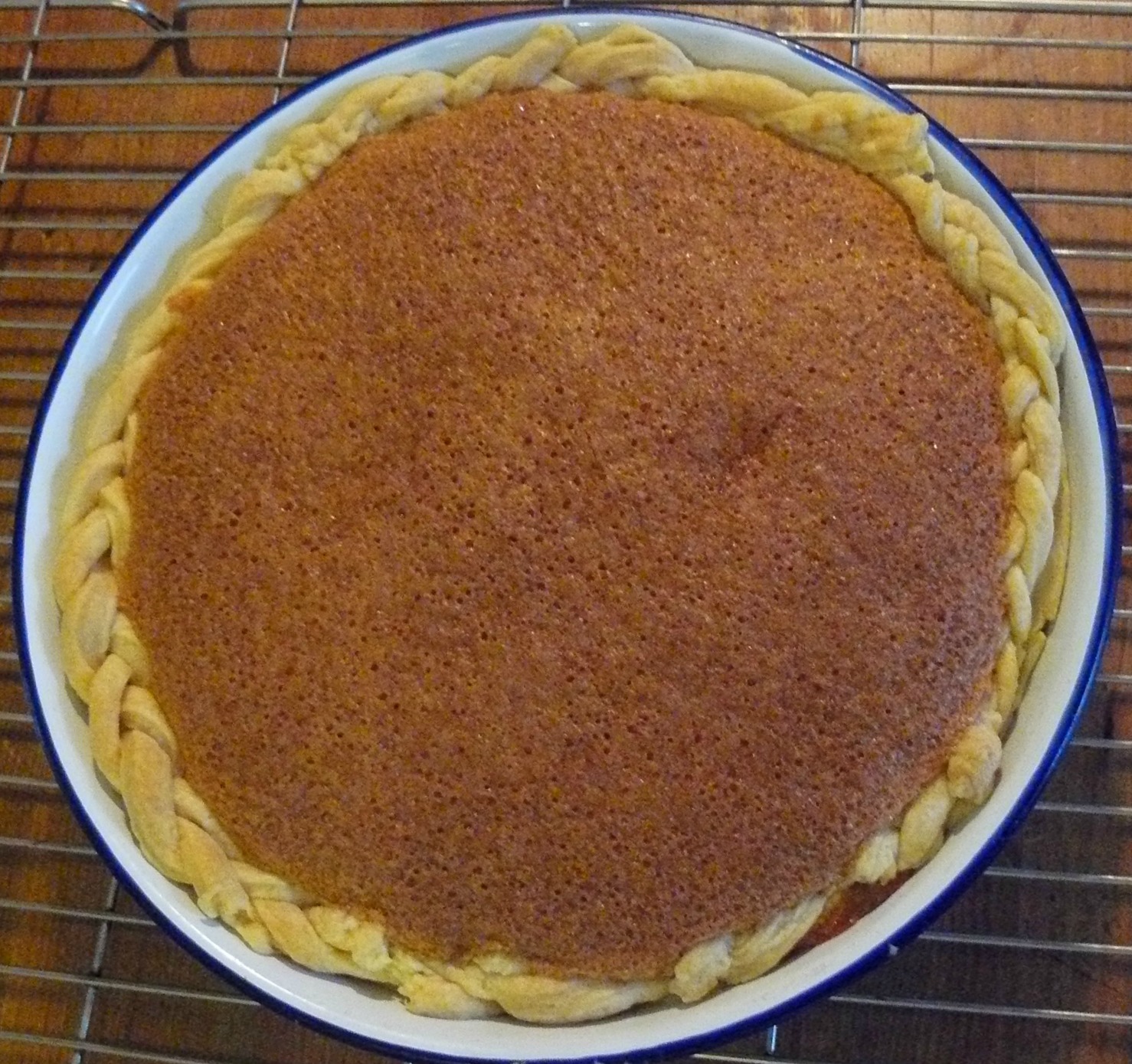
I did not use puff paste, we prefer shortcrust.   I also reduced the proportions a by roughly a quarter because it sounded like an awfully big pudding mix.  Of course there was no dish size specified, oven temperature, etc.     Perhaps I am a little crazy, but I really enjoy that freedom.    My brain roamed around the dishes I had to hand and selected a quite deep nine inch enamelled one.   It was guesswork. It fitted perfectly, I'm getting better at this game!


Here it is just before I popped it into the Rayburn.   The oven thermometer read approx 150 degrees.   I baked it for an hour, until it looked and sounded right.


We let it cool quite a lot, but then we could wait no longer.  Time to dive in.


It was very jammy - remember that half inch of preserve?
Remember, too, that there were no breadcrumbs or flour used in the mixture.  


How to describe the taste and texture?   Well, when it was still slightly warm it reminded me of banana fritters, which is very strange because I have not eaten any for almost sixty years.    It was delicious, just unusual.

My husband thought it tasted almost pancake-like and I could see what he meant.

The following day I tried a slice which had been chilled.    It was very nice indeed!   The pastry was crisp, the jam oozed, and the 'fritter/pancake' had subtly changed, although I couldn't explain the taste or texture.

I cajoled my daughter into trying a slice - she enjoyed it and described it as being like a firm egg custard in taste and texture.   She came back for seconds, so I think we can chalk up a success for the experiment.

Still not convinced about the 'superiority' thing though.

It was nothing like a Bakewell Tart!   More refined?  Perhaps.  Different?  Definitely.   Superior?  Never!

ps  Despite this, I would make it again.

Tuesday, 21 February 2017

Treasured Recipe Books - A Family Receipt Book


Lined up like this they don't look particularly impressive, I know.   However, these are my most treasured books and whole reason this blog exists.   It is my collection of handwritten recipe books.   Some are beautifully bound, others could do with rebinding and this is something which I must investigate when time permits, although I have no idea of how much such a job would cost.   I would like to preserve and protect them for future generations to enjoy.

Note to self:  Find a local bookbinder and discuss!


I had to start somewhere, so I chose this one as it is the one I used most recently.

Leather-bound, nicely tooled and with a thin gilt decoration.   The spine is deteriorating and I must get something done about it.


The endpapers are beautifully marbled, I remember watching them create paper like this when I visited Florence, quite a number of years ago.   So simple, but so effective.


This book has an index, which is quite useful, many of the others either don't have one, or they are partial ones, perhaps begun with an enthusiasm which waned.


Page 107 is the final recipe - Medlar Jelly.     I wonder why this is the final one.   The handwriting looks quite firm and strong, not at all as though the writer were ill.   Quite often a book will then be taken over by another person but not this one.   About half the book remains empty.   The book has obviously lived quite a life and has been handled a lot.  

I like that.

No recipe tried out here, but don't worry.   More food trials to come!

Sunday, 19 February 2017

A Superb Coconut Pudding from Jamaica, 1880


Sometimes it takes a while for a particular recipe to come to my attention.   
Max really likes coconut, so I am always looking for recipes which incorporate it,
so it is strange that I hadn't noticed it before.

It was written in this book in 1880, when it was noted that it was "given
to M.L.K. by a Cook in Jamaica".

This is how it is written up:


 Cocoanut Pudding

Grate 3/4 of a cocoanut on a fine grater.   Beat to a cream 2oz of butter with 4oz of sugar.   Then add 1 egg and beat for a few minutes, add another, and so on till you have put in 4, also the whites of 2 additional eggs.    Take 1 breakfast cup of finely grated bread soaked in a pint of boiling milk.    Mix all together adding the the cocoanut, juice of a lemon and 1 glass of brandy.  Pour the pudding into a mould.   Boil for 2 hours and serve with Brandy Sauce.

This morning I recklessly, and suddenly, decided to serve it as a pudding for a big Sunday lunch I was preparing for family and friends.   

When I tipped it out onto a serving plate it felt surprisingly light and I began to feel hopeful that it would be a success.

It was.   I could have done a Happy Dance, so could Max.   It was coconut heaven, most definitely unlike an English steamed pudding.

Coconut flavour with a definite hit of brandy - well, I had been quite generous with the glass-size!

The recipe suggested serving it with a Brandy Sauce, but as the others had some long hours of driving ahead of them, I decided that custard would be a safer option.

Everyone loved it and the dishes were soon empty, but not before I had time to grab a camera and take a few snaps.   Rough and ready snaps because I hadn't planned to post about the pudding but it was so light and scrumptious that it merits the post with bells and trumpets.

Well done that wonderful Jamaican Cook and well done the woman who thought to ask for the recipe.


The photographs are awful, but the pudding was delicious.  I will be making this pudding regularly, it was wonderful.  


It may make it easier if I write it up in a more modern style:

Coconut Pudding

3/4 of a coconut grated - I simply used dessicated, but I will try fresh next time.
2 oz butter
4 oz sugar
4 eggs plus  2 well beaten egg whites
1 breakfastcupful of finely grated breadcrumbs (white)
1 pint of boiling milk
Juice of a  lemon
1 glass of Brandy

Soak the breadcrumbs in a pint of boiling milk.
Cream the butter and sugar, gradually add four well beaten eggs, beating thoroughly between each addition.    Add the lemon juice, brandy, coconut, as well as the bread and milk.
Fold in the lightly beaten egg whites.

Pour into a buttered mould, tie down and steam for two hours.

I am already thinking about perhaps replacing the brandy with Bacardi or rum, just to test it out...     


Wednesday, 15 February 2017

Hunting Nuts v Ginger Nuts

I know very little about most of my old handwritten recipe books, which is a shame.    However there is one, which I posted about here, which was used by successive cooks in a country vicarage. 

Here is a photograph of one of the early pages, before the writing becomes much trickier to decipher.    When I first bought it, at a local auction, where it had been described as a 'school dinner ladies book', I was barely able to read more than a few pages.


I got it very cheaply, probably because no one else could read it either!    Oh what a little gem of a book.   Tatty, worn, grubby from almost two hundred years of use, but I get great pleasure from reading through it - because now, after all these years, I can read the various hands.

I have done some research and I know that it was a wealthy parish, I also know that the Vicar came from a monied background, but not much more.  

The Vicarage provided vast meals for school outings and celebrations, cook made lots of pickles and preserves and lists just how many she had made one year - very impressive, I'll list them sometimes.

It was a rural parish and yet, unlike most of my other recipe journals, 'Mock Turtle Soup' and Sheep's Head Broth do not feature.   More expensive cuts of meat are used.

Enough of my musings.


Today I decided to take pity on Max.   The biscuit tin was empty and he really wanted some gingernuts, like the ones I made last week.

Well that was ok, but I do like to try out new recipes.   I decided to make a batch of Hunting Nuts, too.    Of all the biscuit mixes which I have ever made, the Hunting Nut one is the most wonderful one to make.    It felt like a little magic happened as I mixed them.

Hunting Nuts

Put 8 oz Treacle
8 oz Raw Sugar
8 oz Butter
into a pan on the fire.   Let them melt and simmer and then pour them into a hot pudding basin and put in as much flour as you can mix comfortably.   Add ginger to your taste.   When cold roll them into balls about the size of a marble.   They will keep uncooked one or two months.

The photograph above shows the four Hunting Nuts which I couldn't fit onto the baking sheets - of course I have to use them to test out the claim that they will keep, uncooked, for one or two months.   Watch this space!

As ever, not all measurements are given and cooking instructions non existent.    What fun.   

Back to the recipe, I added 1 oz ground ginger, you may prefer a less fiery flavour, so add less.    For once I was careful to measure the amount of flour which was needed.    I used exactly 1lb 2oz.   As I added the final two ounces the mixture suddenly all came together in one easily managed lump of deep, dark, glossy dough.

It was wonderfully simple to make the marble-sized balls.   I suppose you could bake them in that shape, but I decided to flatten them a little.


Terrible photograph, but here we have  Hunting Nuts
and Ginger Nuts.

I baked them for 15 minutes at 180 degrees.   They came out shiny and beautiful, my daughter thought I had been making macaroons!

This quantity of mix yielded more than four dozen Hunting Nuts.

They firmed up as they cooled and it wasn't long before Max came by to filch a couple.    He loved them.

I also made a batch of Ginger Nuts, I wanted him to compare the two biscuits.

As you can see, one is smooth, the other has chopped peel and a completely different appearance.   


Almost before I had taken the final biscuits out of the oven, my granddaughter Merry came bursting into the kitchen and wanted to help me make a chocolate cake.

It wasn't quite what I had planned (a cup of tea and a rest would have been nice) but how could I refuse?

So we made chocolate cake, from scratch.   It was carefully mixed by Merry (with a little help) iced by Merry and decorated in her favourite way with Smarties, of course.   

Granny's little helper is becoming quite proficient for a five year old.