Welcome!


This is where I note my efforts as I try to recreate some old recipes. Most are taken from my small collection of handwritten recipe books which date from the late 1700's to around 1922. I also have a collection of old tatty old recipe books, well thumbed and heavily splashed from years of use. I love all of them.

The old-fashioned very stylised handwriting writing is sometimes difficult to decipher, measurements and cooking instructions are minimal, no tin sizes given. Luckily I enjoy a challenge. Just to complicate things I cook and bake on my wood-fired Rayburn, which can be... unpredictable.

I suspect this blog is less about the food and more about my passion for these lovely old books and the wonderful women who wrote them.


Sunday, 31 October 2021

Mincemeat and Quince

The days are getting shorter and the trees are beginning to shed their leaves.      The quince tree has done magnificently this year.  The fruit enormous and abundant.   I try to leave them on the tree as long as possible, but the severe winds of the last few days have meant that I had to pick them before they fell - quince are very easily bruised and I didn't want to waste any of them.

A few slices of quince really elevate the flavour of an apple crumble and my family love apple crumble for pudding.    Quince are also very good roasted in with a lot of root vegetables and onions.   This time of year I also drop a few slices of quince into the pot when I make a vat of spinach soup just to add a bit of punch.   

Quince Vinegar is my favourite and I have already made 5 litres of it.   Allowed to mature, meld and mellow for a few weeks, it will be perfect for making salad dressings and for seasoning food.   I plan to make another brew which can be put into pretty bottles and given away as a small additional Christmas gift.

Quince Marmalade, Membrillo, and Quince Jelly are also on the list of things to make.  Quince will be used in puddings and cakes and some will be frozen for future use.   I may even make a bottle or two of Quince Vodka to go along with the gifts of Quince Vinegar.

The remainder will be given away to neighbours, family and friends.

Today, however, I really wanted to get started on making mincemeat, ready for Christmas.


A quick rummage through the pantry and store cupboard soon showed me that I had lots of tail ends of bags of dried fruits which needed to be used up.   So if this years mincemeat is a success it can never truly be replicated because it is a real mixture of the conventional and the exotic.  The usual spices, some veggie suet, brown sugar,  zest and juice of a couple of large oranges, a very large dollop of home made bitter orange marmalade, and some home-grown Bramley apples went into the mix (I could have used quince).


As I came to add the apples it became apparent that I needed to get out my really enormous mixing bowl.  


The smaller bowl is very large; the other one is huge and very old. It belonged to my late uncle.  Quite why he had such an enormous bowl is a bit of a mystery as he only cooked for himself and my aunt and they were frugal eaters.

The bowl has some cracks, one of them quite large, but I cherish it because he used it; he was my favourite uncle.

The orange juice, chopped apples and deliciously bitter orange marmalade were stirred into the mix before I clingfilmed it and set it aside in the pantry for the night.


Earlier this morning I decanted it into a large roasting pan, covered it with foil ready for a two-and-a-half hour bake in a very low oven.    Recipe and photographs to follow in a day or two.


This is Millie in her favourite kitchen perch.  She likes to oversee all food prep from her vantage point.   I'm not sure how much longer she will be able to squeeze her rather ample self into that basket.    

Saturday, 15 May 2021

Four Noggins/Gill = One Imperial Pint = Twenty Fluid Ounces

My daughter likes to use cup measurements, I prefer pounds and ounces.    She teaches Reception and first year children, so her baking classes are designed to make life easy for her and the children, I understand that.      I am always perplexed at the very idea of measuring out a cup of butter, for example.  It sounds very messy, not that the infants in her classes would be bothered, the more mess the better!    

Of course many of todays recipes are given in grams, another alien concept to me; difficult for me to visualise.    Wherever possible I stick to good old Imperial pounds and ounces, although I must admit that digital scales make using the alternative very easy.   

I stick to my beloved Imperial measurements.  Is one allowed to say that these days?

I celebrate Pecks, Gills, Bushels, Noggins and Ounces and I delight in the fact that my mother taught me that a pint of water weighs a pound and a quarter.  Pounds, ounces, stones.

How agile our minds must have been as we answered arithmetic questions which called for  money to be calculated in £'s, shillings and pence - with 12 pence to the shilling, 20 shillings to the £, and 21/- to the Guinea.    

I am old enough to remember being able to purchase some sort of small sweetie from the corner shop for the princely sum of one farthing, four of which made one old penny.   This stimulates other memories of Black Jacks, Fruit Salads and a sour sherbet sweet like yellow sugar,  into which we would stab a  wet finger, delighting in the sharp sour taste and the fun of ending up with a finger which became yellow stained and made us look as though we smoked forty cigarettes a day.     

I digress.   Forget the sweets, celebrate the old Imperial measurements.   Mini rant over, my granddaughter has arrived.


Wednesday, 5 May 2021

Hunting for a Recipe

A few years ago I was whizzing through the abebooks website when my eye was caught by the artwork on one of these recipe book covers.   I clicked on the listing, looked at the photographs, and decided to order the book.  

I should state here and now that I am not pro-hunting, so let's not have any nonsense about that.    They are recipe books, plain and simple.

One book grew into a small collection within my general collection.


Originally they were sold to raise funds for the hunts they represented, but that was thirty or forty years ago.  

The recipes are many and varied, often presented in the donor's own handwriting, on their headed notepaper...surely something which people wouldn't dream of allowing these days?    (I have clipped it off this recipe.)


The recipes are many and varied, heavily weighted on the alcohol side.  Take this recipe for 'Batchelors (sic) Nightcap'  Take one bottle of whisky.  Remove cork.  Pour contents into cut glass tumbler.  Half fill.  Add water to taste and consume immediately.  

Ginger Brush - 3/4 dark Barbados rum with 1/4 King's Ginger Liqueur  (sounds delicious) but I am not sure I would like to try the Coleman Mix which is equal measures of cherry brandy and sloe gin, nor do I like the sound of the Percy Special which is equal measures of whisky and cherry brandy.   

A contributor gave her recipe for a concoction to go into her hip flask, she named it: Sabina's Dutch Courage: Half a bottle of Bell's whisky and half a bottle of Tio Pepe sherry - stir and pour.   It goes straight to the head, is tasty and thirst quenching and fills me with courage as I gallop towards an obstacle.  A good drink out of season too - a good slug before putting the bikini on for the first time is a great help.  Sabina.


Most books also contain hints and tips to do with horses and hunting kit.


It is quite a while since I wrote a blog post and goodness have I become rusty.   This small offering has taken almost a week to write.   In the old days I could dash off a post very quickly.  


Monday, 12 October 2020

2020, A Good Quince Year at Parsonage Cottage Kitchen


I had to harvest the quince a little earlier than I would have liked because high winds and heavy rain were forecast - quince bruise very easily so I didn't want them to fall from the tree under such a vicious assault.    Much better to harvest them gently then let them ripen in the house.


I have given away six large carrier bags of them, but I still have all of these in store.   These are stacked in the outer porch, where it is fairly cool, others are ripening in the kitchen.   The riper they become, the more the wonderful scent of quince develops, which is an added benefit.


I have made a couple more batches of quince marmalade, but there we can only eat so much marmalade in a year.   I also add them to crumbles and fruit pies, they add a delicious extra dimension.    The favourite mix at the moment is a combination of apple, quince and windfall pears.  

Ordinarily I cook fruit in very little water, however one of my old recipe books suggested using more water and, when the fruit is cooked, drain the water off and retain it as a drink.   It sounds strange, but it is surprisingly delicious.

Just as apples are used in baking cakes, so can you use quince.   My most recent cake bake was quince and ginger, a particularly nice combination.

We are still harvesting our own tomatoes, lots of them.   Roast tomatoes with roughly chopped onion, slice in some quince, drizzle the whole with olive oil and add black pepper.   I normally serve this dish with bruschetta.    I must admit that I will be quite sorry to move on to the heavier food of autumn, but then again it is nice to eat seasonally and the leeks are ready to harvest, which makes me think of soup, so perhaps it's not all bad.

It is yellow in colour, as if it wore a daffodil tunic

and it smells like musk, a penetrating smell.

(Taken from the Jane Grigson Fruit book of 1982) 


Monday, 28 September 2020

Quince Marmalet - early 18th Century Recipe

One of the quince trees has been exceptionally prolific this year, which is marvellous.    Lots of quinces to play around with.     I love experimental cooking - trying out old recipes.     I decided to make a batch of Quince Marmalet to an early 18th century recipe which can be found in Florence White's 'Good Things in England'.


Lots of people seem to struggle to peel and cut quinces, I'm not quite sure why that is.   Yes, they are much harder than a pear or an apple, but no tougher to handle than a swede.   I peel them with my usual vegetable peeler, slice them up with my regular knives.    They do discolour very quickly, so have a bowl of water and lemon juice handy to drop them in.


I made my marmalet quite chunky - see the first photograph.   One of the most magical things about quinces is the way they turn such a beautiful rich red colour, if you cook them for long enough.

For each pound of quinces you will require one pound of sugar and one pint of water, plus a little brandy.    I also added some finely grated ginger root but that is optional.

Wipe the fuzz off the quinces, peel and cut into quarters, throw them into cold water.  Put the peelings and cores into cold water and boil them till tender.  Strain off the liquid - and retain it!   When it is cold put the peeled quinces into it, weighing one pound of fruit and one pound of sugar to a pint of water, add extra if necessary.   Boil them all together until tender keeping them close covered.  'Beat them until they be of a right thickness.'

Pour it into warm sterilised pots, cover and label.


I let mine cook for about three hours on a fairly low heat, just giving it a stir now and then to check that nothing was sticking to the bottom of the pan.


That first pot has gone down remarkably quickly so I think we can call that a success.


Back soon with lots more quince recipes.

Saturday, 29 February 2020

Alaskan Whale Stew & Other Delights


Alaska Whale Stew     (Serves 347,161)

1 x 52 ton blue whale
948 lbs tinned tomatoes
7326 lbs potatoes
2276 lbs carrots
104 lbs sat
52 gallons tabasco hot sauce
1896 lbs onions
927 lbs celery
76 lbs black pepper

Place whale in pot with tomatoes.   Cook at 300 degrees (gas mark 2) for four hours.

Add potatoes, carrots, salt, hot sauce, onions, celery and black pepper and simmer for 36 hours.

If you care for hare in your stew add a 2 pound rabbit.

Anonymous     Recipe taken from "Recipes from the Rectory & The Rest"   -  circa 1970's/80's sold in aid of a church roof restoration project.    Apparently every couple getting married in the parish was presented with a copy of the book (the rest of the recipes are all very standard).


Perhaps slightly more palatable:


Paradise Pudding (1830)

If you'd have a good pudding
Pray mind what your're taught
Take two pennyworth of eggs
When they are twelve for a groat.

Take of that summer fruit
Which Eve once did cozen
Well pared and well grated
At least half a dozen.

Six ounces of bread
Let your maids eat the crust
The crumbs must be grated
As fine as small dust.

Six ounces of currants
But pray pick them clean
Lest they grate in your teeth
You know what I mean.

And if you've a mind
To be clever and handy
Put in good lemon rind
And a large glass of brandy.

Six ounces of sugar
Won't make it too sweet
With some salt and some nutmeg
To make it complete.

Three hours let it boil
Without peeps or flutter
And then serve it up
With some good melted butter.

Adam tasted the pudding
T'was wondrous nice
So Eve cut her husband another large slice.

Taken from Recipes from Wrawby, a Lindsey (Lincs) Federation of WI's book, 1937.


Batchelor's Nightcap

Take one bottle of whisky.  Remove cork.   Pour contents into cut glass tumbler.  Half fill.   Add water to taste and consume immediately!

This one was taken from 'Hunting Cook' compiled by Rosemary Eustace.


Sunday, 12 August 2018

A Note of Sadness

One of the problems about getting so involved with these m/s recipe books is that I feel as though I almost know the women who wrote them.


I can see how they start out so enthusiastically using their best handwriting, etc.    Recipes abound, interspersed with recipes for soothing babies suffering from wind, croup and the like, as well as how to treat sore breasts - presumably from breastfeeding.

Over the many pages the handwriting slowly changes and evolves, often becoming shakier, entries dwindle.

The tan-coloured book (right next to the blue)  has a high quality binding  and extremely beautiful handwriting within.    

It was begun in 1851 and was used for many hundreds of recipes and receipts, then in 1917 it was briefly used for a few dozen entries by someone else.

The entry which caught my eye today, was the penultimate one entered by the original owner, C Cooper.

Nourishment when nothing else will stay in the stomach

The white of an egg. well whisked.  then add a tablespoonful of cream to a tablespoonful of brandy.  😟  

It always makes me think of my mother, she died about 25 years ago, from stomach cancer.   It seemed a particularly cruel fate for someone who really enjoyed her food, to go.


Wednesday, 27 December 2017

Royal Sauce for Plum Pudding & a Kitchen Supper for 60 Persons


Plum Pudding, Christmas Pudding, call it what you will, we never eat it on Christmas Day, we simply don't have the stamina these days.   

There is, of course, the perennial question of what to serve with your Plum Pudding, our preference is for custard, but I know a lot of people prefer brandy butter, cream, or even rum sauce.     Rich and heavy pudding made even richer?  No thank you,  I'll stick to a well made custard sauce, our digestions can cope with that, but each to their own.

One of my old handwritten recipe books gives this recipe, dated December 1862, a note says that it was given by Lady Cagley's Cook.

Royal Sauce for Plum Pudding
Beat a 1/4 lb butter to a cream then add by degrees 3 oz of very fine loaf sugar.  When well beaten add 1 glass of wine and 1 of brandy.   It should be sent up in a boat and should look like thick whipped cream.

Sounds like a version of Brandy butter to me.


The same book gives a recipe for Christmas Puddings - vast quantities of them.

3 lbs flour
10 lbs currants
10 lbs raisins
3 lb bread crumbs (2 loaves)
4 lbs suet
1 oz candied peel   I wonder whether this was supposed to be 1 lb?
2 oz allspice
2 lbs sugar
1 1/2 dozen eggs
Milk to mix
1/2 pint Brandy

Boiled for 9 1/2 hours in basins.

Why such a large quantity?   Well this was a vicarage cook and my did they know how to feed large numbers of people.


Kitchen Christmas Tea and Supper - 60 persons present

Elder Wine
56 lbs Beef cooked for 9 hours - properly done(!)
1 Joint of Cold Pork
15 Puddings
2 Tarts
6 Loaves
3 lbs Butter
Plum Loaves
3 lbs Sugar
1/2 lb Tea
1 Pint Cream


Dining Room Tea - 25 Persons

Portion of above, plus
Cold Tongue
Eggs
Cakes
1 Pint Cream
1 lb Sugar
Bread and Butter

The above quantities were more than sufficient with regard to Meat and Pudding.   Bread, Tea, Sugar and Cream just about right.


The book was written by a cook at a vicarage.  Luckily for me, the name of the parish is mentioned once, so by the magic of internet and sheer curiosity, I have  managed to find some photographs of the vicarage in question as it is presently up for sale.   It is a big old place with enormous rooms, Grade II listed.

It gave me quite a thrill to be able to look at photographs of the old kitchen and dining room where the writing, cooking and eating took place, way back in 1848!

Tuesday, 26 December 2017

Books, Books, Books


As this is my 'kitchen' blog, here are some of my new books.    They are all rather battered and worn with not a single high-gloss photograph between them.  Exactly the kind of recipe book I love. 

They are not as old as some, the oldest one dates to 1930's, but the recipes within are much older.  Some have hand written notes, splashes and splodges, which all add to the charm, in my opinion. 

Before Christmas I bought a copy of Nigel Slater's new book, The Christmas Chronicles.   I have flicked through it and no doubt it is an excellent read, but somehow it doesn't call to me in the same way as these books.

Enjoy Boxing Day.   

Left-overs for us, surely the best part of the Christmas Feast...and we certainly won't be visiting the sales.   It is a day for extra-long walks with the dog and then a guilt-free hour or two spent reading by the log fire.


Saturday, 23 December 2017

Parsonage Cottage Kitchen at Christmas


The older I get, the more I seem to enjoy Christmas.    Simple things, like getting out the Christmas china,  baubles and decorations for the tree, and some of my mother's favourite old cake decorations.


My helpful Kitchen Angel - a rather large, golden, papier mache cherub - also makes an appearance.  She has been watching over my festive kitchen cooking for almost twenty years and has more or less ensured that everyone is well fed and happy.

Today has been a happy, pottering kind of day and I have made mince pies, shortbread, tomato and garlic bread, regular white bread, English muffins,  and I have a large pan of red cabbage with cranberries and apple gently cooking in the Rayburn.

I had fairy lights a-twinkling, carols and Christmas hits playing on the radio.   Bah humbug! you may say, but I enjoyed it.

These days we host a Christmas Day breakfast party for the family, which means that by around midday peace descends upon Parsonage Cottage.   We could go out to eat with the family, but we enjoy this small oasis of peace and quiet, after years of hosting enormous Christmas Day lunches.     

We'll settle down in front of the fire for a quiet afternoon


punctuated only by the demands of the cats or the need to walk the dog.   My husband will tuck into his very favourite Christmas food - turkey and piccalilli sandwiches and I will indulge in a smoked salmon sandwich - as we watch the Queen's Speech and then dip into our new books.    Bliss!

Merry Christmas, however you celebrate it.
xxx

Sunday, 3 September 2017

A Nut Loaf for Nutting Day


September 3rd was traditionally known as Nutting Day, which is when children would go out into the local woods to collect hazelnuts.


Nut Loaf

6 oz/175 g butter
6 oz/175 g caster sugar
3 eggs
8 oz/225 g self raising flour
1 oz/25 g ground almonds
3 oz/75 g mixed chopped nuts
2 tablespoons milk

To Decorate
4 tablespoons apricot jam
3 oz/75 g walnut halves
3 oz/75 g whole brazil nuts


Heat the oven to 170C/325F/Gas 3

Beat the butter and caster sugar together, until light and fluffy.  Beat in the eggs, one at a time, adding 1 tablespoon of the flour with each egg.
Stir in the ground almonds and chopped nuts with the rest of the flour.
Add 1-2 tablespoons of milk, to make a soft consistency.
Turn into a buttered and lined 2lb/1kg loaf tin and bake for 1 1/4/1 1/2 hours.   Turn out on to a wire rack to cool slightly.
Warm the apricot jam and pass through a sieve.  Brush half on to the warm cake and decorate with the nuts.  Brush with the remaining jam and leave to cool.


The cake is light and moist, beautifully textured with the chopped nuts.   Will definitely make this one again.

Recipe found in A Calendar of Feasts Cattern Cakes and Lace by Julia Jones and Barbara Deer, published 1987.

Thursday, 24 August 2017

Recipe Book Cover Fun


As well as making and baking plenty of food and cakes, this summer has also featured a bit of fun as I played around with echoing some recipe book covers.

The most fiddly bit is getting things set up at the right levels, varying heights so that the photograph looks good, rather than slavishly following what is on the cover.   Just go for the spirit of the cover and suddenly it becomes very easy and it is surprising just how many 'props' are to be found around the home.

I hope you have had some summer fun.

ps Plenty more book cover art can be found over on my Parsonage Cottage blog.

Monday, 21 August 2017

Village Show


On Sunday our tiny village hall came to life for the Annual Village Show.  After months of meetings and trying to generate some interest, it finally all came together and the tables were filled with fruit, vegetables, cakes, jam, pickles, craft works, photography and fabulous flower displays.

What a relief.

It is one of those quintessentially English events where outwardly calm facades hide those deeply competitive streaks.    Many of the village people have nothing to do with the event, so thank goodness we have some fabulous people who do take the time and trouble to grow, make, bake, jam, pickle and create things for the show.


One year we had the infamous 'Sconegate' incident... involving a judge firmly rooted in WI standards and our fabulous local foodblogger, Dom of belleaukitchen.com, who had baked the most sumptuous and beautiful scones - alas, he had baked them man-sized - and they were therefore demoted because of this.  This led to murmurings of witchcraft and/or skulduggery of some kind and there has never since been a 'Scone' class...

How much poorer our village would be without his wonderful support and participation.

This year it was especially difficult to keep things going because our committee numbers are so depleted.   Fortunately, on the day, several people who had not been able to help with the preparations turned out to help with the general work of selling tickets, filling in forms and helping with the refreshments.  Phew!

The doors were closed at 11am, the judges had arrived and they took their work very seriously indeed.   Jams and pickles were tasted, salad dressings, ditto.  Cakes were cut and nibbled, notes made.  Bread was sawn open and prodded, poked and sampled.  Judgement made, the certificates were filled in and best of category selected.

By 2pm the work of judging had been completed, so had the paperwork, and the doors were opened.  In rushed the crowd to scan for prizes, assess the judging, cakes and tea were consumed and raffle tickets drawn.

It was fun!

Without events like this, which do take a lot of work, but which draw a community together, the village would be a much duller place.     People come together and have fun, they sit and drink tea, chat and wait for the awards and raffle.

They turned out and they participated and the hall was buzzing with conversation and fun.

The tradition of the Village Show has been maintained.

Sunday, 4 June 2017

Boodle's Club Cake Good.


I should state here and now that brandy has nothing whatsoever to do with this recipe!

I was just trying  to convey a sense of Boodle's Club, which is a private Gentlemen's Club and the second oldest club in the world.   It was founded in 1762 and has had some illustrious members.   Membership is strictly by nomination and election - no riff-raff allowed!

I can, however, bring you a recipe for their special fruit cake.


I took delivery of this old, 1930's recipe book, yesterday morning - Caviare to Candy by Mrs Philip Martineau.

It is the kind I book I love - lots of recipes which don't call for a million ingredients, minimal instructions and few illustrations.   You have to rely on your back knowledge and instincts.  I don't always get it right, but it does make baking fun.

I was drawn to 'Boddle's Club Cake' first of all because the name appealed to me - but mainly because the word 'Good' had been written next to it.

That is another thing I like about these old books, the notes, the splashes, the evidence of years of use.

A cake was required for the weekend - my choice was made for me.

"One pound of flour, half a pound of butter or margarine, half a pound of Demerara sugar, half a pound of raisins, two eggs, one and a half teaspoons of bicarbonate of soda, one gill of milk.

Beat butter and sugar together, then the eggs, chop raisins (I didn't) and mix with flour, stir in gradually; dissolve soda in the warm milk and beat all well together.   Bake in a moderate oven for two and three-quarter hours.  (Very good.)"


What a wonderful cake!   It is a light fruited sponge cake, but with a sort of butterscotch/caramel flavour.   It goes perfectly with a cup of tea - no brandy was consumed - I was still playing with the Gentlemen's club theme when I took the photographs.

The family loved it.

I loved it.

This has gone straight to the top of my 'easy bakes' list.


You can now find me on Instagram as parsonage_cottage_kitchen.

Thursday, 18 May 2017

Cheese and Olive Bread


This is a bit fancier than the bread which I normally bake, but it turned out to be a really easy recipe to follow and the resulting bread was delicious - crisp, flaky outer shell with cheese and olive filling - think a very large, crisper, savoury croissant and you are almost there.  

Delicious warm/hot straight from the oven, or reheat later.

9 oz bread flour
1/2 tsp salt
1 tsp caster sugar
1/2 sachet yeast
3 1/2 fl oz hand-hot milk
1 egg, beaten
2 oz butter, chilled and cut into very small cubes

FILLING
2 oz stoned olives, sliced
4 oz cheddar cheese, grated
1 egg, beaten
salt and freshly ground pepper

Mix together the beaten egg and warmed milk and then add them to the dry ingredients.   Turn the dough on to a board and knead until smooth and elastic.     (Compared to the vast batches of bread which I normally make this was a tiny amount and I found it a joy to knead such a small quantity!)

Place in a clean, greased bowl and cover.  Leave to double in size - about 30-40 minutes, depends how warm your kitchen is.

Turn the dough out and roll into a 6x12 inch rectangle.    Dot the bottom two-thirds of the dough with half the butter.   Fold the top third down over the centre third and then the bottom third up.  Seal the edges.   (All much easier than it sounds.)
Place the dough on a plate and chill for about 20 minutes.


Mix together the filling ingredients, save a little egg for glazing.
Roll the dough out into an oblong about 8x12 inches.   Spread the filling over the surface.  Roll along the long side, like a Swiss roll.   Shape into a ring.  Mine was more like a horseshoe, but never mind!
Place on a greased baking sheet.  Make a series of cuts around the ring, brush with beaten egg.   Leave to rise for about 30 minutes.

Plae in a preheated oven 220C/fan oven 200C or gas mark 7.

Bake for 25 to 30 minutes.  Transfer to a wire rack and wait for the gannets to descend.


I found the recipe in a WI book - Best-kept Secrets of the WI.

The outer bread case was crisp and flaky, the filling was like a savoury croissant.    When I make it next time I'll use a more mature cheese for a stronger flavour, but that is down to personal taste.   The grandchildren thoroughly enjoyed it, even if one did pick out all the olives.


Saturday, 13 May 2017

Chocolate and Rhubarb Tart

Chocolate pastry with a layer of chocolate custard topped with rhubarb which has been gently poached in red berry coulis.


I served it with an extra portion of the berry coulis - sharp, tangy, and delicious.   

Indulgent?  Yes!   

Sweet chocolate and tangy fruits, unctuous custard over a lovely crisp pastry base.   If you are not so keen on the sharper notes just add more sugar to the fruit.

I used a Victorian recipe for the pastry.   I am tweaking the balance of ingredients at the moment because I found it very difficult to handle.    Once I have it perfected I will post it here.     This pastry makes the most delicious and crisp base for a tart or pie.

Make a thick chocolate custard and spread it on the base of the baked pastry shell, top it with the poached rhubarb and add a little of the red berry coulis.    Chill.  Serve with extra red berry coulis.  Simple!

Because I made this up as I went along, I haven't got any accurate weights and quantities to share with you, next time I make it I will take note.

I used two sticks of rhubarb, washed, trimmed, stringy bits removed, sliced about half an inch thick and very gently poached in red berry coulis.

The coulis was simply made with some red berries from the freezer, I defrosted them and then gently heated them in a saucepan, along with a dessertspoonful of dark brown sugar.     I just let them do their own thing on the slow plate of the Rayburn, so the heat was very gentle.

Push the berries through a sieve and discard the seeds.   The resulting coulis didn't look quite enough to poach the rhubarb in, so I added a small glug of blackcurrant juice and then tumbled the rhubarb into the pan and left them to slowly and very gently poach.  The key to this is a really low heat.   The rhubarb will cook through but will also keep its shape and take on the most beautiful ruby red colour.

Pile the cooled rhubarb on top of the custard, pour over a little of the coulis.   

Chill the tart for an hour or so and then enjoy those taste and texture sensations!


Saturday, 22 April 2017

Stuffed Monkey

Stuffed Monkey - how could I resist?
I found the recipe in 'English Food' by Jane Grigson, 1974.
My initial reaction was to wonder what on earth such
a recipe could be doing in the 'Teatime' section
along with cakes, scones, bread and buns.


Rest assured, no monkey was harmed in the making of this dish.

It is something of a mystery as to how it got such a name.
Jane Grigson got the recipe from a Jewish Cookbook
written by Florence Greenberg.


My interest was piqued, not least by the unusual name
and
also by the apparent simplicity of the dish.


Recipe

6 oz flour
Half tsp cinnamon
4 oz butter
4 oz soft brown sugar
1 egg, separated

Make a dough with the flour, cinnamon, butter, sugar and egg yolk, mix it as though making pastry.
Roll it out and cut into two rounds to fit into an 8 inch cake tin.
Fit the first round into the buttered tin.


1 1/2 oz butter
2 oz chopped peel
1 oz caster sugar
2 oz ground almonds
1 egg yolk

Melt the butter and then beat in all the other ingredients.
Spread the mixture over the pastry.
Cover with the second round.
Tuck the edges in neatly.
Brush with the egg white.
Bake at 190 C/375F for about 30 minutes.
Cool in the tin and then turn out carefully.


The outer case is crisp and flavoursome while the filling is almost marzipan-like,
 very dense, rich.
It is a fabulous teatime treat
or
a coffee-time treat.
Any time treat.
Indulge yourself!

Easy to make.
Stores well.
Tastes delicious.
Excellent!


Wednesday, 19 April 2017

Herb Pudding for Spring

This first pudding was traditionally made in Staveley Village, in Westmorland - the North West of England.    It can only be made in Spring, when the nettles are young and tender and when wild green herbs grow in abundance.

You will need:

Any kind of edible young green herbs, wild ones
such as Easter ledges (none available around here, I used wild garlic instead)
young nettle tops (wear rubber gloves!)
young dandelion leaves
lady's mantle (alchemilla)
or your choice of spring herbs - several handfuls.
One hard-boiled egg
One raw egg
Half an ounce of butter
pepper and salt.


We have lots of nettles, plenty of dandelions, lady's mantle, wild garlic and chives, so that's what I settled for.   Easier said than done, though.  

The first problem I encountered was that of finding enough young dandelion leaves, preferably located in places where the dog could not possibly have lifted his leg...     The nettles came from Owl Wood and so did the wild garlic.    Lady's mantle came from where the old summerhouse was located and the chives from the herb garden.

Wash them thoroughly!    Really thoroughly, it is amazing what comes out of those greens.    I'm squeamish, I know, but I also know what runs around our gardens and the woods at night time.    Just saying!

Put the greens into boiling water and boil for 10 minutes.

Drain.    I drained and squeezed until the greens looked like dry boiled spinach.   (I should have squeezed a third or fourth time, for I ended up with a small puddle around the pudding.)   Then chop the leaves and add the finely chopped boiled egg.

Next, add the beaten egg, the butter and seasoning.

Return the whole to the pan and cook through briefly.

Put the (tiny) mixture into a hot pudding basin to shape it, then turn it out and serve.


I popped a wild garlic flower on top for decoration.       You can see that pesky liquid around the base.


Taste test:   Surprisingly delicious!
Would I make it again - Yes, I probably would.


Another Herb Pudding,   this one comes from a different Westmorland village,  Burnside.

The basics are the the same, but you leave out the raw egg and add a couple of tablespoons of boiled barley.


I am a fan of pearl barley, I like it in soups and I liked the addition to this pudding.   It just added a little more body to the dish.   Less juice dribbled out of this one, I had almost wrung it out sufficiently!


The dish is really intended to be served as a side dish to meat.
The recipe came from Florence White's book - Good things in England (1932)


Playtime over, I got down to the real business of the day...


Four individual apple crumbles and a loaf of no-knead bread.
x

Sunday, 16 April 2017

Baking and Cooking

It has been a busy time, here in Parsonage Cottage Kitchen.
Lots of cooking and baking, virtually no photographs because I was too busy.
This one more than makes up for it, for me.


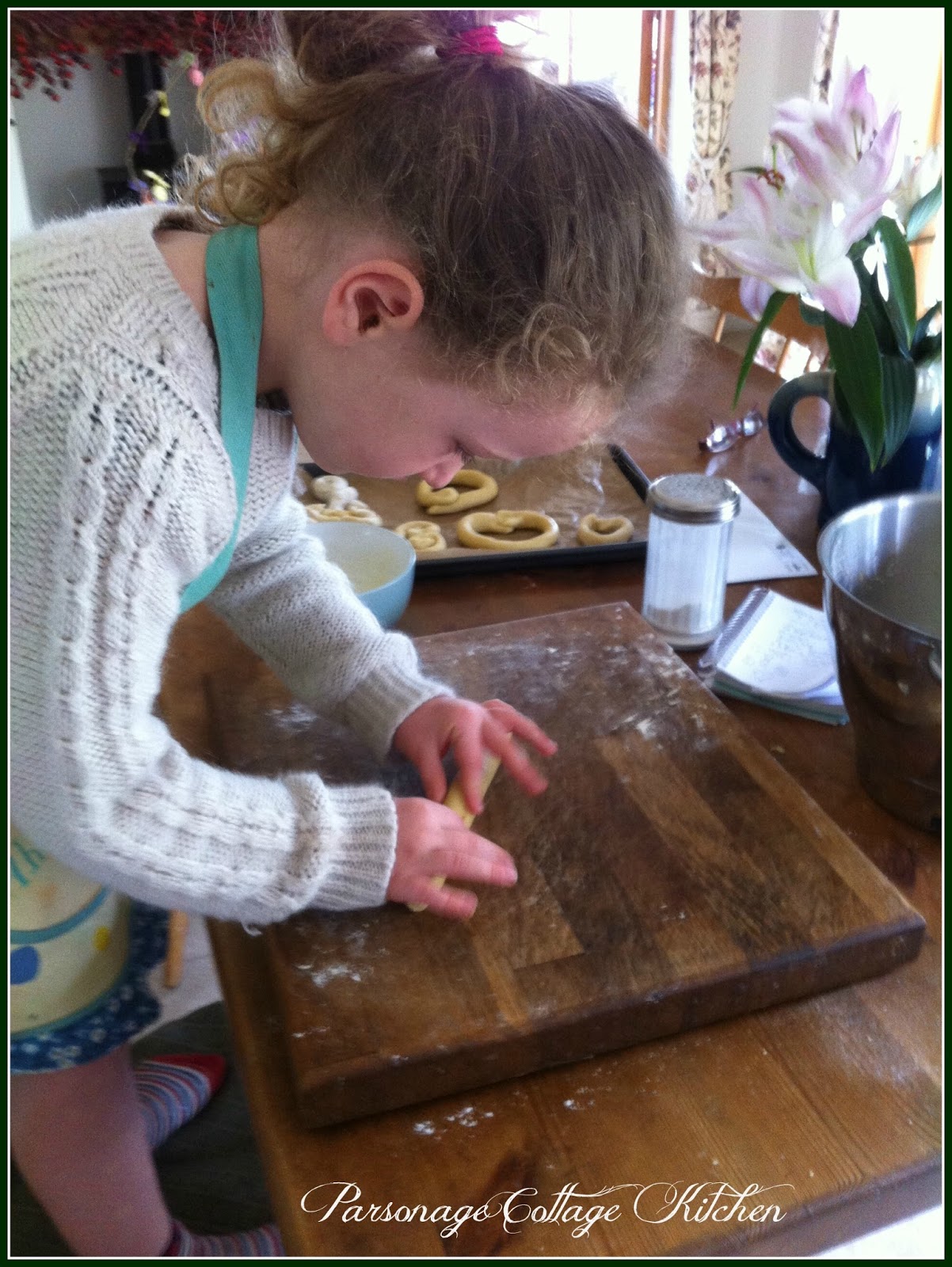
Young Merry made a batch of koulourakia, Greek biscuits.   Thanks, Linda.   They were enormous fun to make and were enjoyed by all the visitors.

I set aside my personal scruples, roasted a large ham.   I made sure that it was British and outdoor reared, I had to at least have the consolation that the poor pig had had some quality of life.    I also roasted a large chicken - free range, of course.   That was the less than pleasant stuff out of the way.


Baking:

A very large quiche, mushroom, wild garlic and cheese.
A vast Lemon Meringue Pie
Chocolate Cake, with frosting.
Carrot Cake
Two varieties of bread
Hot Cross Buns
Koulourakia
Shortbread


Roast Ham
Roast Chicken
Tabbouleh
Mixed Salads
Boiled New Potatoes with Mint, Butter and Sea Salt
Crudites and Hummus

plus all the things which I bought rather than made - cheeses(!) ice cream, pickles, etc, etc.


We were feeding all three of our adult children, their partners and children.   The party was twelve in number and food disappeared at a rate of knots.   Even so,  there was plenty left over.

I made sure that they all took parcels of their favourite left overs, but there is still a fridge full of deliciousness.   No need for me to cook or shop for quite a while yet.

I need to lie down in a darkened room to recover.
x

p.s.  Everyone sends their love, Ian.   They wanted to know about the boat and your adventures!xx