Welcome!


This is where I note my efforts as I try to recreate some old recipes. Most are taken from my small collection of handwritten recipe books which date from the late 1700's to around 1922. I also have a collection of old tatty old recipe books, well thumbed and heavily splashed from years of use. I love all of them.

The old-fashioned very stylised handwriting writing is sometimes difficult to decipher, measurements and cooking instructions are minimal, no tin sizes given. Luckily I enjoy a challenge. Just to complicate things I cook and bake on my wood-fired Rayburn, which can be... unpredictable.

I suspect this blog is less about the food and more about my passion for these lovely old books and the wonderful women who wrote them.


Tuesday, 31 May 2016

Rich, Crumbly and full of Chocolate Chips

Practicality decided what I should bake yesterday.

We needed something indulgent, but practical, which could be enjoyed 'on the go' and which would also please the grandchildren, for it is half-term and they are constantly popping in and out of Parsonage Cottage  hoping for a snack.


I was sorely tempted to have a go at making some 'Hunting Nuts' to a recipe found in one of my Victorian recipe books but decided to save that fun for another time, for they are  flavoured with ginger, which is not to Merry and Hector't taste - yet!  Much safer to stick to good old chocolate chip cookies.


Max adores anything homemade, but if it comes with added chocolate then he is very happy indeed.   Chocolate chip cookies should please them all and will be handy for when the electrician and the plumber come in this week, to finish their work at Cowslip Cottage.

Luckily this recipe makes about five dozen cookies, so plenty to go round.


They are perfect with milk, and also with coffee.tea.


So that is the tea breaks sorted for the next week, now I need to get back to my painting.   Just the hallway, staircase and landing (plus ceilings) and one bedroom to go!


These are delicious but they are high-fat, high sugar, full of chocolate.  If you are on a health-kick, avoiding sugar, fat and chocolate, or are the fat police, then please look away now.

Chocolate Chip Cookies

Cream 450g butter with 250g of icing sugar, sift in 500g plain flour and half a tsp salt, mix together with a teaspoonful of vanilla extract, then work in 600g of chocolate chips.

Line your baking trays with parchment, roll up your sleeves, tune into 'The Archer's' or whatever you like to listen to, then make dozens of dough balls.  We like medium sized ones, which take about a generous tablespoonful of dough.   Roll them in your hands, put them on the parchment, flatten a little with a fork.

Bake at 350 degrees for approx 12/15 minutes, or until they are ready.  Cool on a rack.

Store in an airtight tin, they will keep for a long time.


Monday, 30 May 2016

The Wonderful Thing about Books

..is that they can set you off on a journey of exploration and adventure.

My old kitchen journals have done just that.


Max and I are still busy working on trying to get Miles  and Poppy's cottage fit for habitation (they return from China in just six weeks) and spend the rest of our time wandering around wild-eyed,  clutching lists entitled  'Jobs To Do' and 'If We Have Time'.    They are constantly being amended and adjusted according to whether we feel energetic and optimistic, or the more usual state which is too tired to sleep, brain on overload.  

I have still found time to fit in some reading - of course!

I read one excellent detective story by James Oswald, but apart from that I have enjoyed exploring the theme of food in history.

My recent birthday meant that I have had a clutch of gift cards and book tokens burning a hole in my pocket..... of course they almost all went on books,  which are allowing me to explore historical recipes and social history.

You just wouldn't believe the time-travel I am able to indulge in from the comfort of my desk in the conservatory.   I haven't made these journeys by myself for I have been in the company of some wonderful writers.

It will take me years to work my way through all the books, so far I have merely dipped in and out of them, snippets of information being about as much as my brain can cope with as we race towards the finish line with the cottage.

Of course I have also fitted in some cooking and baking, people still have to be fed, no matter how tired the cook.    No 'new' recipes tried out for a while, but I have found myself baking the Victorian Chocolate Cake, the Rhubarb and Custard Cake and the Ginger Cake (with Cayenne pepper!) for these have become firm favourites and are easy to make as well as being delicious.

I shall be spending this morning painting the final coat on the kitchen walls and ceiling (at the cottage) but after a snack lunch, and a snooze, I must do some baking for we have a glut of eggs.  

Besides which the cake tin is empty and I feel in the mood to explore another old cake recipe.

Wish me luck.

Tuesday, 17 May 2016

Queen Mab Pudding


Our speckledy hen is called 'Queen Mab' and she, along with the rest of our small flock, lives in our little patch of woodland where they roam free among the trees.   They spend their days wandering through the bluebells,  Queen Anne's Lace and wild garlic a-scritching and a-scratching, doing all the things which hens are supposed to do.  Lucky girls!


Queen Mab variously known, and written about, as 'Queen of the Fairies' 'The Fairies' Midwife'.   Shakespeare has her in Romeo and Juliet and she features in other literature and poetry.

Fairy Queen, or speckledy hen, she is quite a character and I was excited to be making a pudding which bears her name.


A quick read of the recipe revealed that Queen Mab Pudding is basically one of those good old English custard puddings.   To make it fit for the Fairy Queen Mab it is studded with jewel-like pieces of angelica and dried cherries and served with a ruby red sauce.


There are many recipes for it but the one I used was found in one of my old handwritten recipe books.


So, in this unknown cook's words:

Queen Mab Pudding (Cold)

1 1/2 pints new milk
4 oz lump sugar
1/2 teaspoonful of vanilla flavouring (extract)
1 oz gelatine soaked for an hour previously in 1/2 gill cold water
5 eggs
Put all ingredients into a saucepan together and stir with a whisk until it boils.  Have ready the yolks of 5 eggs beaten with a wooden spoon.   Let the milk just cease boiling and pour it over the eggs and put all into the saucepan again and warm it, to thicken a little.   Chop up some pieces of angelica and dried cherries to put it to the custard.   Have ready a mould rubbed with salad oil, and lay at the top about 4 pieces of angelica, then pour in the custard and let it go cold.  When cold turn it out and pour over it the sauce as follows.
1 oz lump sugar
1/2 gill cold water
1 tablespoonful of red jam, warm all together in a pan, let it go cold and pour over the pudding.


It was quick and easy to make, a cool and delicious custard pudding.

The first time I made it I had to use shop-bought eggs, they were organic and free-range, so I thought they would be the best substitute for our own home-grown ones.  


A couple of weeks later when I made it again, I used eggs from our own hens, who enjoy a daily bunch of spinach as one of their treats.   The difference in colour was amazing - the resulting custard base was much richer and more yellow.

I had run out of red jam to make the sauce, so I simply poured a little cream over it and a scattering of fresh raspberries again.  It worked very well.


.  


It was fun exploring that particular recipe but I don't think it will be necessary to make it again, delicious as it was.


Wednesday, 11 May 2016

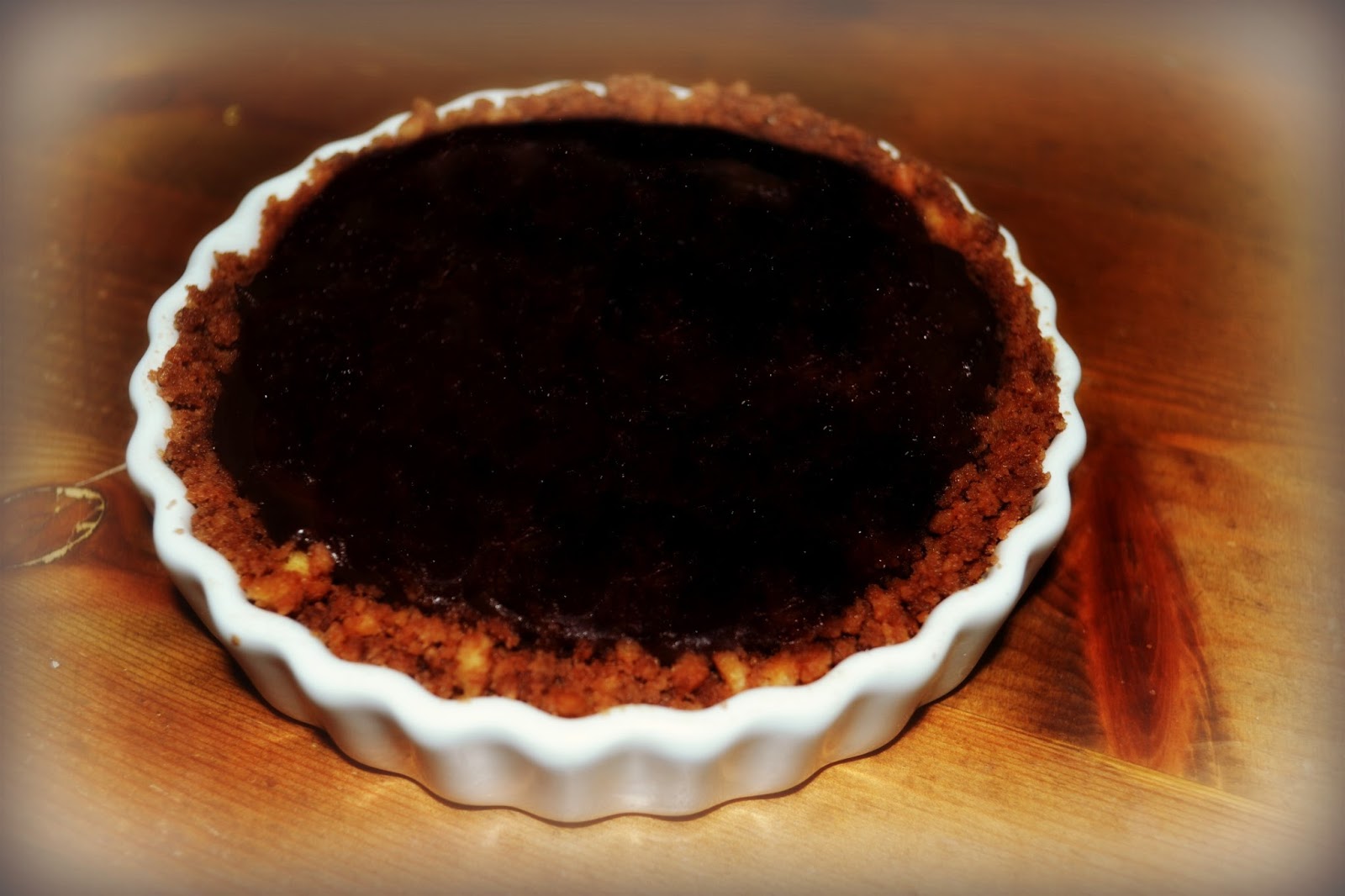
Tweaked Chocolate Tart


The tart filling is rich and spicy thanks to a beautiful combination of really good chocolate laced with both cinnamon and lemon zest.

I found the recipe in the Georgiana Hill book 'A Year of Victorian Puddings' which was originally published in 1862, with the title 'Everybody's Pudding Book'.   It contains recipes for every month of the year.   There are minimal directions and no illustrations but I rather like that.


The recipe called for puff paste but I really don't like it, and neither does Max, so I decided to make a crunchy biscuit base instead - just butter and crushed digestive biscuits.


'Well beat the yolks of six eggs, add to them two dessert-spoonsful of flour, half a pint of new milk, two ounces of sugar, the fresh-grated rind of a lemon, a teaspoonful of powdered cinnamon, and a quarter of a pound of the best French chocolate scraped smooth.   Put all this into a saucepan, stir it over the fire until it gets pretty thick, then let it stand until cold.   Line a tart mould with a thin puff-paste, lay in the pudding, beat up the whites of the eggs to a very high froth, put them on the top, and bake for twenty minutes.  When done, sift sugar over it and glaze it with a salamander.'

Another couple of problems there: I don't like meringue and I certainly don't like plain whisked egg whites on the top of a pudding/tart, I could just have added sugar and made a proper meringue, but I decided to leave that topping off.

A couple of weeks ago it was my birthday and one of the gifts which Max gave me was some excellent chocolates and a large tin of Classic Drinking Chocolate.   The drinking chocolate is so delicious you could eat it straight from the tin, so I decided to sprinkle it on the top of the tart.   It worked a treat and also looked great.


So there you have it a slightly spicy and rich chocolate tart.   My chocoholic, Max, quickly dived in and declared it a complete success.  10/10 for this one.  I would definitely make my version again.

Wednesday, 4 May 2016

Parsnip and Lemon Pudding

I couldn't resist trying out this recipe, it was the word 'parsnips' in the list of ingredients, which drew me in.  


Lemon Pie

1/4 lb flour
2 oz lard
2 or 3 parsnips
2 lemons
1 gill milk
honey
sugar
2 egg yolks

Make pastry in the usual way and line the base of a tart dish.    
Peel the parsnips and slice them thinly.  Gently cook them in the milk until very soft, you may have to add more milk part way through.    Pound them into a paste and add some honey and a large spoonful of honey, beat well.   Add the egg yolks and beat, then beat in the grated rind of the lemons and the juice.  Put into the dish and bake in a fairly hot oven until set - 20/30 minutes at about 200 degrees C.


Sounded nice and easy, and it was easy to make and bake.


The resulting tart resembled nothing more than the base for a lemon meringue pie, in fact I was tempted to whip up some meringue and pop it back in to bake.    I resisted doing that because then it wouldn't have been as close to authentic as I could make it.

So, the taste test.   It was very lemony, slightly soft, but delicious.   I served it with a spoonful of Greek yogurt and the combination worked well.

It was an interesting experiment but I think that it would have been a lot better with potatoes, rather than parsnips, I may try it some time.  


This was the Potato Pudding-Pie which I baked a few weeks ago - that one got 10/10.  The lemon and parsnip tart is awarded a 7/10.  

A week or two ago I made a carrot pudding, when I remember which book the recipe is in, I'll post about it.   That was definitely an 8/10.  


I have enjoyed this exploration of the ways in which vegetables were used in sweet dishes, with the exception of that totally disgusting cauliflower pudding, which really was the stuff of nightmares whereas the pies and cheesecakes made with ordinary white potatoes have been the most popular with my family.  


(ps For Poppy and Miles ~ I really like the wall lights you have chosen. xx)


Saturday, 30 April 2016

Rich Chocolate Cake, a Victorian Recipe.

I don't know exactly how old this recipe is but it was certainly being used in the mid 1800's.     However old the recipe, the resulting cake is a chocoholics delight.


 No need for a dollop of cream or fancy embellishments,  it was perfect as it was.


The chocolate frosting was not part of the original recipe, although almond or chocolate icing was suggested.     

I used my all-time favourite chocolate icing recipe, which is taken from an old book entitled, Tea with the Bennets of Jane Austen's Pride and Prejudice by Margaret  Vaughan.  

The cake recipe, just as it is written in my book:

Four ounces of butter, six ounces of sugar, eight ounces of flour, two ounces of ground chocolate, two large eggs or three small ones, half a teacupful of milk, one teaspoonful of baking powder, half a teaspoonful of ground cinnamon, a few drops of vanilla.   Beat the butter and sugar to a cream, add the eggs well beaten, with a little flour, mix thoroughly; dissolve the chocolate in the milk on the fire, add to the other ingredients.   Bake one hour, or until quite firm.  This cake is much improved if iced with almond or chocolate icing.

I used some really good quality cocoa powder which I had been given, in place of the ground chocolate, and mixed it with 150 ml of boiling milk, making a stiff  paste.  I also substituted self-raising flour for plain but I still used the teaspoonful of baking powder.   I used two 8" cake tines with baking parchment lining the bases.   I baked them at 180 degrees for about 30 minutes, but do check your cakes and use your own judgement.


Allow the cakes to cool and then sandwich together with a good layer of jam, or if you are really into chocolate, you could use more chocolate icing.

Now, that chocolate icing - dark, full of chocolate and exceedingly easy to apply - even for someone like me.  It takes the stress out of icing and yet gives a great finish and an excellent taste.

3 oz icing sugar
1 oz cocoa (use really good quality cocoa)
1 1/2 oz butter
2 tbspns water
2 oz castor sugar
1/2 tsp vanilla extract

Sift the icing sugar and cocoa into a basin.  Put the butter, water, caster sugar and vanilla into a saucepan and stir over a low heat.  Just bring to the boil and remove from the heat at once.   Pour into the middle of the dry ingredients and beat with a wooden spoon until smooth.  Leave to cool, stirring occasionally.

Ice your cake and tuck in.


Another Victorian Chocolate Cake - tried it and it is even better than the first one.

8 oz flour
2 tsp baking powder
1/4 tsp salt
2 oz dark chocolate
8 fl oz milk
5 oz butter
10 oz soft brown sugar *
3 eggs
1 tblsp black treacle
1 tsp vanilla extract

* I didn't have enough soft brown sugar, so I used half soft brown and half molasses sugar.

Sift the flour, baking powder and salt together.   Put the milk and chocolate to warm, stir, when melted and set aside to cool.   Cream the butter and sugar, add the eggs one at a time and beat well.  Add flour and egg alternately.   Mix well then add the chocolate and milk, you will end up with a thick batter.   Pour into tins and bake.

I used two 8" tins and baked the cakes at 180 degrees.

Cool on a wire rack. 

Cover with that amazingly easy and totally delicious chocolate icing (above).   
Scrumptious, but then my family always demolish chocolate cake.
x


Friday, 29 April 2016

Foraging - Wild Garlic

Foraged from our small woodland
wild garlic leaves, primroses, rosemary.


A few years ago my friend Dominic, of Belleau Kitchen fame, was kind enough to tell me where there was an enormous stretch of wild garlic growing locally.    It was alongside, and running up, a small hill, on a leafy little loop of road which I rarely use.  It was a revelation and so pretty with the white flowers and pungent with the smell of wild garlic.

Max and I decided that our little patch of woodland would probably be ideal for cultivating some of our own, so we obtained a few bulbs, planted them, protected them from our free-ranging hens, and then hoped for the best.

Success!  The wild garlic is now happily growing in several parts of the wood.   Luckily for us our hens do not seem inclined to sample it, garlic flavoured eggs just wouldn't be good, especially in a chocolate cake...or egg custard.


Wild garlic has the same medicinal properties as garlic but the taste is much milder, but I love the flavour and the colour in food.

I picked a basketful and decided to make some wild garlic bread with it.


I added a good handful of finely chopped garlic leaves to my bread dough and continued as normal.


The result was superb.   A herby, slight garlic flavour permeates the whole of the loaf.   It makes a wonderful base for a sandwich, excellent toast and flavoursome croutons.   A delicious seasonal treat.


Bread is my greatest weakness, I can resist chocolate, cakes, biscuits, crisps - please note that I said 'can' not 'do', but good bread is definitely my absolute favourite food, and this one is a winner.


Nettle and spinach soup with wild garlic bread.

I dried a basketful of leaves in the lower oven of the Rayburn.  By the following morning they were crisp and crunchy and ready to be finely chopped and then put into tiny spice jars, wild garlic salt.


Useful for sprinkling on savoury dishes to give some colour and a tiny hint of garlic flavour.


Did I mention how wonderful the garlic bread was when toasted?  Just a hint of garlic not overpowering but a definite flavour.


I made garlic bread croutons, they disappeared almost before I could take a photograph.


Just one more thing - don't forget to add wild garlic to your scones.   A good handful of finely chopped wild garlic, along with some grated parmesan cheese, cayenne pepper and some good English mustard powder and the resulting scone is light and full of flavour.


So good that people came back for seconds and thirds.


My dear daughter finally conceded that I make better scones than she does, for today anyway.